Microservices Contract Driven Testing
In the world of microservices architecture, ensuring that independently deployable services interact correctly is a significant challenge. Contract testing has emerged as an essential approach to tackle this challenge effectively. Spring Cloud Contract, a part of the Spring Cloud suite, provides robust support for contract testing, ensuring that HTTP and message-driven interactions between services are verifiable and consistent. This article delves into the realm of contract testing with Spring Cloud Contract, offering insights into its principles, implementation, and benefits.
The Essence of Consumer Driven Contract testing
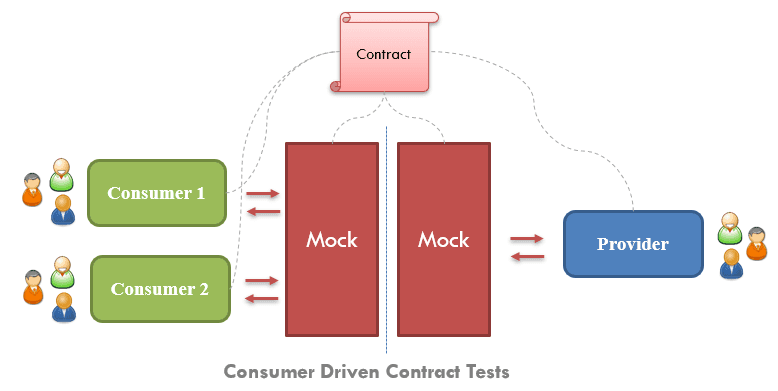
CDC testing is fundamentally consumer-centric. It shifts the focus from the service provider to the consumer, ensuring that the services meet the specific needs of their consumers. In this model, the contract is the cornerstone, serving as the definitive source of truth for both parties involved. It outlines how the service provider’s API should respond to requests, thus setting clear expectations.
Advantages of CDC Testing
The adoption of CDC testing brings several benefits to microservices development:
- Minimized Integration Issues: By setting clear expectations through contracts, CDC testing reduces the likelihood of integration problems, ensuring that updates or changes in the service provider do not unexpectedly break consumer functionality.
- Support for Independent Development: CDC allows services to be developed and deployed independently, as each service only needs to adhere to the contract.
- Enhanced Communication: It promotes better communication and understanding between teams, as the contract acts as a focal point for discussions.
- Speedier Development Processes: CDC testing can reduce the dependence on extensive end-to-end testing, thereby accelerating the development process.
Implementing CDC in Microservices
Implementing CDC testing typically involves a few key steps:
- Contract Creation: The first step is defining the contract. This is usually done in a user-friendly format like JSON or YAML, and tools like Pact, Spring Cloud Contract, or Swagger are often employed for this purpose.
- Consumer Side Implementation: On the consumer side, the contract is used to simulate the provider’s responses during testing. This simulation allows the consumer to test its handling of the provider’s data without needing the actual service to be operational.
- Provider Side Validation: For the service provider, the contract serves as a basis for testing whether the service meets the consumer’s expectations. This is generally achieved through automated tests that verify the service against the contract.
- Contract Management: Effective management of contracts, including sharing and versioning, is crucial. It’s important to have a systematic approach to handle changes in service APIs and ensure ongoing compatibility between different service versions.
Spring Cloud Contract: A Primer
Spring Cloud Contract is a Java-based tool that supports Consumer Driven Contract (CDC) testing. It enables developers to write contracts that define how services should interact, and then generates tests to verify that these contracts are being honored.
Key Concepts of Spring Cloud Contract
- Contract: A document that describes the expected requests and responses for an API.
- Producer: The service that exposes an API.
- Consumer: The service or client that consumes the API.
- Stubs: Test doubles that mimic the behavior of a service for testing purposes.
Implementing Contract Testing with Spring Cloud Contract
Spring Cloud Contract provides a streamlined approach to implement contract testing. This guide illustrates how to use Spring Cloud Contract to test interactions between simple microservices, with step-by-step examples.
Scenario
Let’s consider two microservices:
- User Service (Producer): Provides user details.
- Order Service (Consumer): Consumes user details from the User Service.
Step 1: Setting Up the Producer (User Service)
- Create a Contract:
In the src/test/resources/contracts directory of the User Service, create a Groovy contract.
user_service_contract.groovy:
Contract.make {
    request {
        method 'GET'
        url '/user/123'
    }
    response {
        status 200
        body([
            id: 123,
            name: 'John Doe',
            email: 'john.doe@example.com'
        ])
        headers {
            contentType(applicationJson())
        }
    }
}
2. Configure Spring Cloud Contract:
Add the following dependency in your build.gradle or pom.xml:
dependencies {
    testImplementation 'org.springframework.cloud:spring-cloud-starter-contract-verifier'
}
3. Generate Tests and Stubs:
Running the build process will generate tests and stubs based on the contract.
Step 2: Implementing the Producer’s API
- Create a REST Controller:
In the User Service, implement the REST controller that meets the contract.
UserController.java:
@RestController
@RequestMapping("/user")
public class UserController {