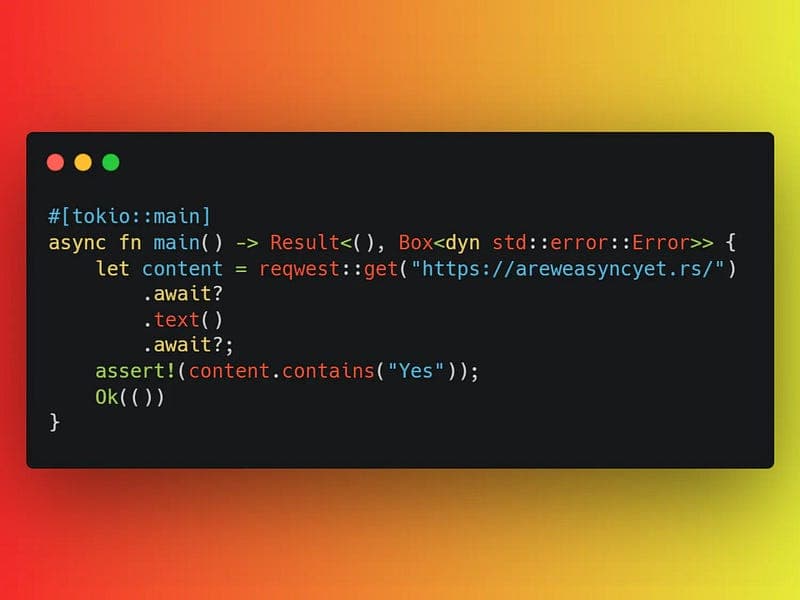
What is Tokio?
Tokio is a runtime for asynchronous programming in Rust, built around the abstraction of the future. It leverages the power of Rust’s ownership and concurrency model to process multiple tasks concurrently without the overhead of threading. It offers a range of utilities for writing asynchronous code, including an I/O driver, a timer, and an asynchronous task scheduler.
How Tokio Works
At the core of Tokio is the concept of asynchronous or non-blocking I/O. In a traditional synchronous environment, the system waits for a task to finish before proceeding to the next task. However, tasks can run concurrently in an asynchronous environment like Tokio, allowing the system to work on other tasks while waiting for an I/O operation to complete.
Tokio’s asynchronous system works based on three main components:
- The Reactor: The reactor, also known as the event loop, is a system component that receives and handles events. It waits for events to happen, and when an event occurs, it delegates the event to the corresponding task for processing.
- The Executor: The executor is responsible for running asynchronous tasks. It schedules tasks and executes them concurrently.
- Futures and Tasks: A Future in Rust represents a value that may not have been computed yet, and a Task is a future that the executor schedules for execution. These tasks are non-blocking and can yield control when not ready to proceed, allowing other tasks to run.
Together, these components allow Tokio to handle a large number of connections with minimal resource usage.
Use Cases of Tokio
Tokio excels in the following use cases:
- Networking Applications: Tokio’s async I/O makes it perfect for developing network applications like HTTP servers, web proxies, or chat servers.
- Real-time Systems: Real-time applications that handle many concurrent connections can benefit from Tokio’s non-blocking I/O.
- Microservices: Microservices communicating over the network can leverage Tokio’s features for efficient operation.
- Command-Line Tools: Asynchronous programming can help create command-line tools that run tasks concurrently.
Implementation Examples
Let’s illustrate a simple implementation of an HTTP server using the Tokio and hyper libraries:
use hyper::service::{make_service_fn, service_fn};
use hyper::{Body, Request, Response, Server};
use std::convert::Infallible;
use std::net::SocketAddr;

async fn handle_request(_req: Request<Body>) -> Result<Response<Body>, Infallible> {
    Ok(Response::new(Body::from("Hello, World!")))
}

#[tokio::main]
async fn main() {
    let addr = SocketAddr::from(([127, 0, 0, 1], 3000));
    let make_svc = make_service_fn(|_conn| {
        async { Ok::<_, Infallible>(service_fn(handle_request)) }
    });

    let server = Server::bind(&addr).serve(make_svc);

    if let Err(e) = server.await {
        eprintln!("server error: {}", e);
    }
}
This code creates an HTTP server that listens on localhost at port 3000. When it receives a request, it responds with “Hello, World!”. Notice the #[tokio::main] attribute before the main function: it marks the entry point of the Tokio runtime.
Advanced Concepts in Tokio
In addition to the basics, understanding advanced Tokio concepts can help create more complex and efficient applications.
Streams
Streams in Tokio are sequences of asynchronous values. They are similar to iterators, but instead of blocking execution, they yield multiple times. Streams can represent sequences of events or asynchronous I/O. For example, a stream could represent incoming messages from a WebSocket connection.

